From a competition to the opening
Utzon and the Sydney Opera House
How the Sydney Opera House came to be: the 1956 competition, Jørn Utzon's design, the spherical solution, the tiles, 1966, and the opening in 1973.
Reserve your seats at the Opera House ↗Quick answer
A Danish architect, Jørn Utzon, won an international competition for the Sydney Opera House in 1957. Construction began in 1959, Utzon left Australia in 1966, a team led by Peter Hall completed the building, and Queen Elizabeth II opened it in 1973. UNESCO listed it as a World Heritage Site in 2007.
The competition
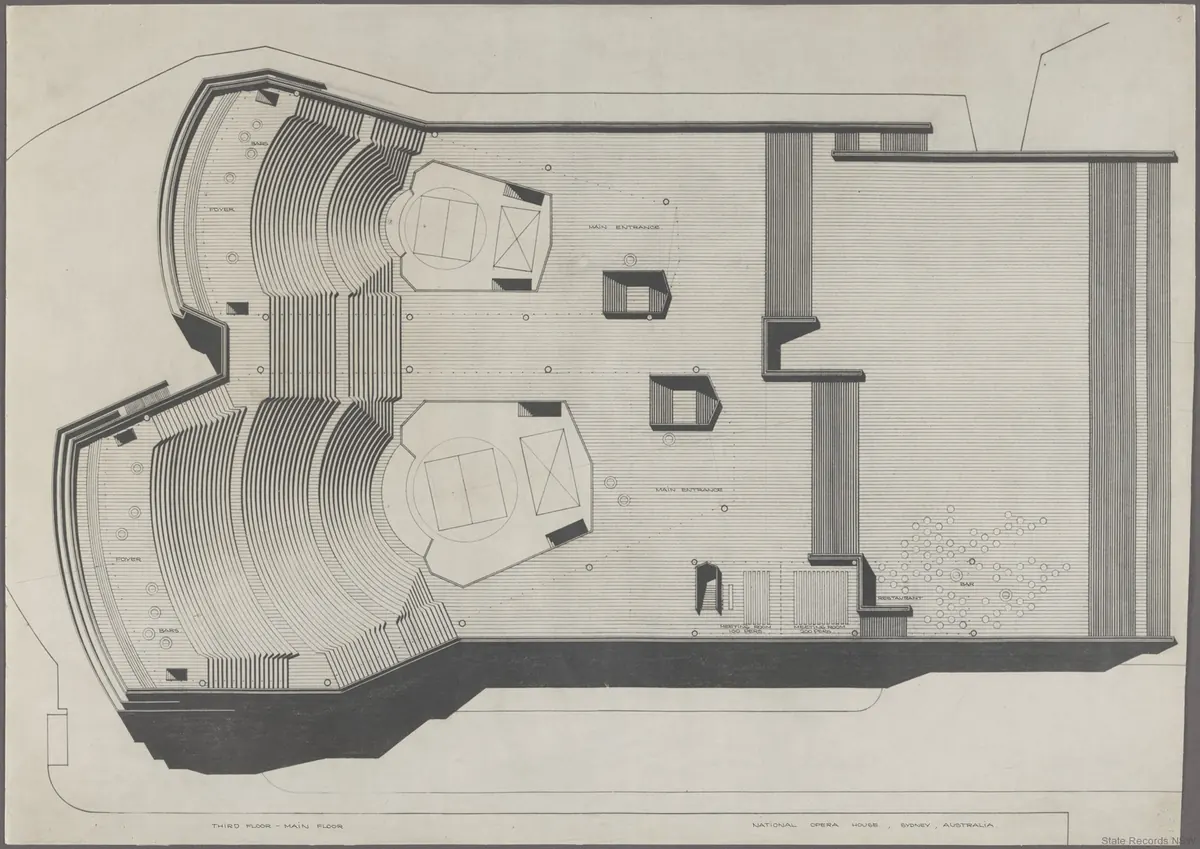
In 1956 the New South Wales Premier, Joseph Cahill, released an international competition for a National Opera House at Bennelong Point. The Opera House says the competition drew entries from 28 countries, and that Utzon's design was numbered 218. A panel of four judges chose the winner, and in 1957 the Premier announced that it was Design 218 by Jørn Utzon, an unknown Dane from Hellebæk.
What Utzon proposed
Unique among the entries, Utzon's design placed the concert halls side by side, their shell-shaped roofs cantilevering out over the end of Bennelong Point and evoking Sydney's cliffs and the sails on its harbour. The Opera House says he pored over nautical maps of Sydney Harbour and was influenced by Kronborg Castle near his home in Hellebæk. The assessors wrote that because of its very originality, it is clearly a controversial design, and that they were absolutely convinced of its merits.
Construction begins
In 1959 a crowd gathered under umbrellas, in the rain, to watch the ceremony that marked the start of construction. Utzon had arrived in Sydney with a bronze plaque, which Cahill screwed into place at the point where the axes of the two halls would intersect, and which can still be seen on the steps today. The geology of Bennelong Point had not been surveyed accurately, so concrete shafts had to be bored down into the site before building could rise. Stage One was completed in 1963, behind schedule.
The spherical solution
Between 1958 and 1962 the roof design evolved through parabolic, ellipsoid and finally spherical geometry. The Opera House says the realisation that the form of the shells could be derived from the surface of a sphere marked a milestone in 20th century architecture. It meant the form could be prefabricated from a repetitive geometry, and a uniform pattern could be achieved for tiling. In 1962 Utzon submitted his Yellow Book, which set out the shells, the precast ribs and the tiling.
The tiles
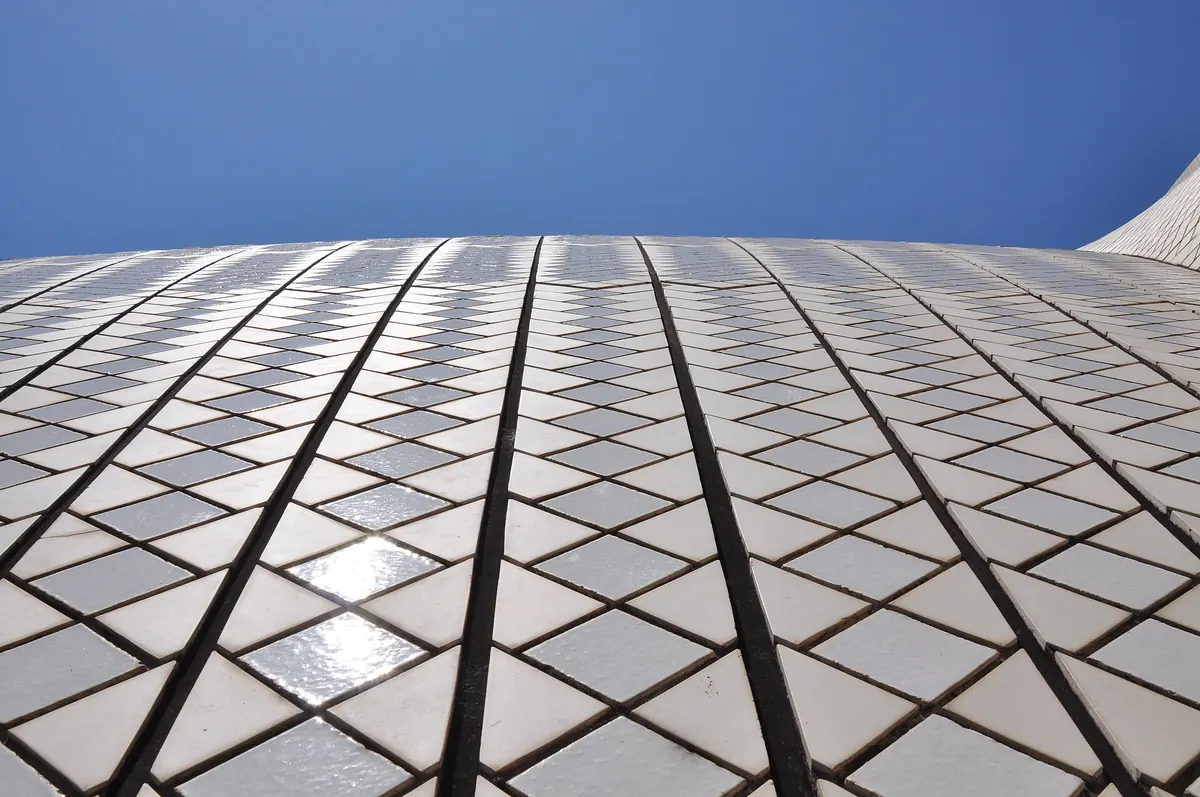
Utzon wanted the shells to contrast with the deep blue of Sydney Harbour and the clear blue of the Australian sky. He found the finish he wanted in Japan: ceramic bowls with a subtle coarseness caused by a granular texture in the clay. Years of work by Höganäs of Sweden produced what became known as the Sydney Tile, made from clay with a small percentage of crushed stone. The tile chevrons that cover the shells were produced in a factory set up under the Monumental Steps, and in total there are 1,056,006 tiles on the roof.
1966 and the opening
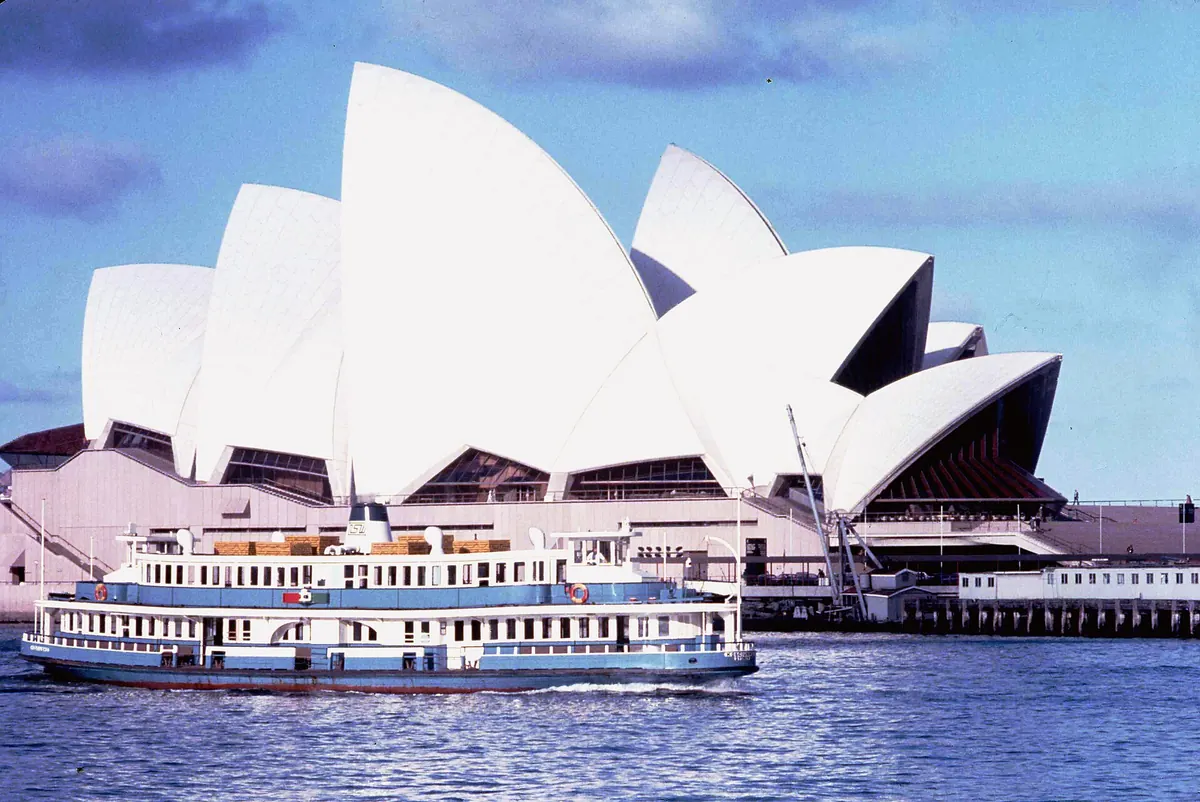
Relations between Utzon and the New South Wales Government fell apart as costs mounted. In 1966 Utzon left the project, and the Minister for Public Works appointed a new panel of Australian architects, with Peter Hall in charge of design. Utzon and his family flew out of Australia. The building was completed by a team headed by Hall and formally opened by Queen Elizabeth II in 1973.
Recognition
Utzon received the Pritzker Architecture Prize in 2003, and the Sydney Opera House became a UNESCO World Heritage Site in 2007. UNESCO says that when the project was awarded to Utzon by an international jury in 1957, it marked a radically new approach to construction. It calls the Opera House a great architectural work of the 20th century, made of three groups of interlocking vaulted shells which roof two main performance halls and a restaurant.
Frequently asked questions
Who designed the Sydney Opera House?
The Danish architect Jørn Utzon, whose Design 218 won the international competition announced in 1957.
When did it open?
Queen Elizabeth II formally opened it in 1973.
How many tiles cover the roof?
The Opera House says there are 1,056,006 tiles on the roof.
Why did Utzon leave?
Relations with the New South Wales Government fell apart as costs mounted, and he left Australia in 1966.
When did it become a World Heritage Site?
In 2007.
Sources
- Sydney Opera House: Jørn Utzon AC
- Sydney Opera House, English Wikipedia
- Sydney Opera House: construction begins
- Jørn Utzon, English Wikipedia
- Sydney Opera House: the spherical solution
- Sydney Opera House: Utzon departs the House
- Sydney Opera House: Peter Hall and the completion of the Opera House
- UNESCO World Heritage Centre: Sydney Opera House